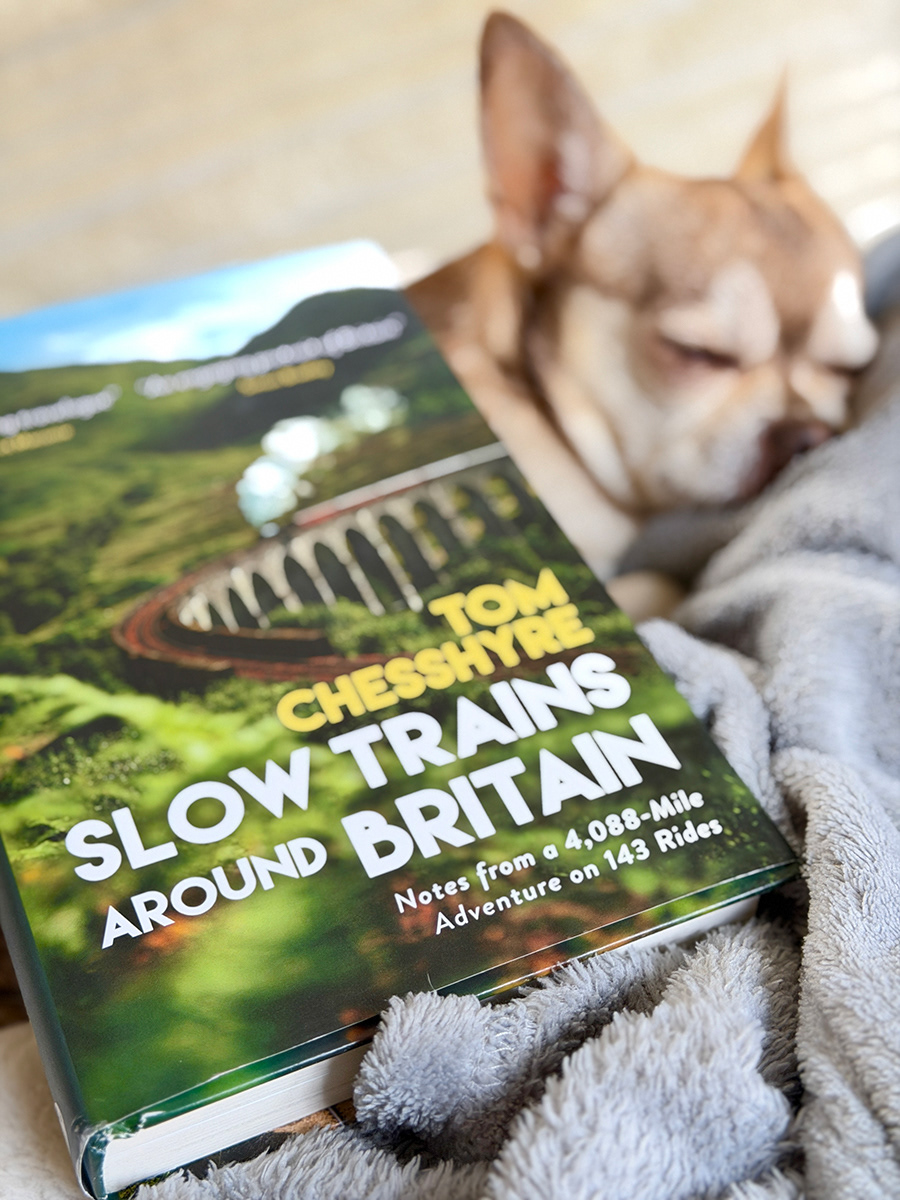
Slow Trains around Britain by Tom Chesshyre.
Slow Trains around Britain (Skegness ft. John Byford)
The train rattled and hummed onwards, following a long curve and arriving at Skegness.
I found my B&B down a suburban road near the station, where a man with gold rings and a weather-worn face showed me to a cold, tiny single room.
“Your toilet’s down there,” he said.
“The room isn’t en suite?” I asked.
“You didn’t pay for en suite,’ he replied. This was true. Mistakenly I hadn’t.
Then the man said, “You’ve got to be out by ten.”
Then the man recommended a Wetherspoons for dinner, and I walked into the middle of the rainy, low-season seaside resort, passing blinking amusement arcades and tattoo parlours, to the Red Lion Wetherspoons pub - right by the station, as it happened, and decorated with old railway posters, including one of the “Jolly Fisherman”.
The railway had come to Skegness in 1873, attracting a steady stream of tourists, mainly working-class people from the East Midlands, before hitting the big time with its 1908 poster. The seaside resort, like Bognor Regis, had been designed by a local bigwig; in this instance, by the 9th Earl of Scarborough (1813-1884), who saw the potential of railways and created a grid of streets on his land near where a fishing village had been and invited speculators to invest.
In the morning - having left before ten o’clock (after a night in a freezing room) - I began some “Jolly Fisherman” investigations.
These formed a three-step manoeuvre.
First, a visit to the Jolly Fisherman statue by the beach, erected in honour of the huge boost to the town’s prosperity made by Hassall’s artwork. Next up, a visit to the town hall to admire two original paintings of Jolly, as he was known in “Skeggy, as Skegness was known. The third step was visiting a local historian/photographer named John Byford at his terraced house down the road from the town hall.
John had scruffy blond hair, thick-framed glasses with a slight tint and a couple of days’ stubble. He wore jeans and an old polo shirt, and had a down-to-earth, slightly distracted manner. He made me a coffee and we talked Jolly Fisherman and trains for a while in the room by his kitchen.
Or rather he talked a lot. I was just happy to listen.
“Jolly is everything to Skegness, he said. He’s our Al celebrity, our legend. When a shop opens, the town mascot [a person dressed as Jolly] will be invited to it.”
Everyone in Skegness liked Jolly, John said. As they did his creator.
“When John Hassall drew the Jolly Fisherman in the poster in 1908, he was already a well-known poster artist,” he continued. He’d done Blackpool, and done book covers and stuff for London Underground.
But the Jolly Fisherman is what he’ll be remembered for_
Hassall had quickly become a local hero, despite not visiting before creating the poster. When he eventually did come, and it was only once, he was greeted by Billy Butlin at the station and taken to the County Hotel in the evening and wined and dined, said John. He was given the freedom of the foreshore and a free deckchair and free entry to the swimming pool forever.
But there was a story behind the poster: In 1904, youll find the Jolly Fisherman in a book called Around the World A/Z by John Hassall representing the ‘P’ for Penzance. But he was known as the ‘Dancing Boatman’ in that.”
So the Jolly Fisherman was really a Dancing Boatman and might, if Penzance had picked up on his potential, have created a stampede of tourists on three-shilling rides from London down to Cornwall.
How did John know all this? “The University of Essex did some research,” he replied, sipping his coffee.
But why did the poster have such a big effect?
“Because the ones before were posters in a posh, art nouveau-style as though for the south of France, covering places like the English Riviera,” John said.
. “If you’re going to attract working-class people, these people, the working class, who suddenly have more money in their pocket thanks to holiday pay, they wanted something else. It’s believed a railway employee came up with the ‘It’s SO bracing’ slogan. When the words and the image came together, they were made for each other. These days ‘bracing’ has images of cold, but back then it was ‘invigorating’ and associated with good health. Being skinny wasn’t a good thing back then, and healthy living in some of the big cities with coal and smoke required getting away on trains. People were coming for clean, fresh air, to clean lungs out and have good food - proper fish and chips. And to feel the sand between their toes. I think Jolly captured all of that. The poster pokes you in the eye. It doesn’t just smack you in the face, it pokes you in the eye.” Railways, as ever, were key.
“In the late 1800s the railway came, the Earl of Scarborough was behind it,” said John. “Mainly for vegetables - the lines were for transporting vegetables back then. Shifting potatoes.”
The web of lines across Lincolnshire was even nicknamed the “potato railway”.
“But the earl saw a potential to put more bums on seats,” John continued. “The railway is fundamental to Skegness and, to be honest, it would have been very difficult to get here otherwise. Even now we don’t have a motorway. But imagine getting to Skegness back then, getting across all the fields from Leicester, Nottingham and Derby. These places are still where visitors come from to this day.”
Yes, tourism had fallen from its early twentieth-century heyday: “In the 1970s, British seasides suffered from everyone buggering off to Benidorm, all these Spanish places.” But things had been picking up: “During Covid, and then as we came out of the post-Covid world, people have been GRIMSBY reluctant to get on a plane.” So Skegness had picked up business. “What do people do when they come? They go to the beach. It’s our biggest asset.”
I was not surprised to learn that John had opinions about Dr Beeching. “Under Beeching even Skegness almost lost its railway. Lincolnshire suffered horribly under Beeching’s cuts. It’s criminal what happened to Louth,” he said. Louth was a nearby market town. “Louth has grown and grown, but it’s not on a railway. No one understands the problems of the county… people relying on the car, with petrol getting more and more expensive. In Lincolnshire, if you’re without a car, you’re lost.”
John paused and said, “It’s such a rural county. If you mention Lincolnshire to anyone, they’ll say it’s just a flat county with vegetables. These lines are how the humble fish and chips became popular.
Fish from Grimsby and potatoes from Lincolnshire, then they got round the country on trains. It’s how the national dish got to Britain.” He returned to Jolly. “Oh, he’s been used and abused in tabloid papers, cartoons, books. It’s just amazing how used and abused over the years.
Most politicians have done the Jolly on the beach - Boris Johnson, all of them.”
By “done the Jolly on the beach”, he meant imitate the pose.
I thanked John for his time, feeling lucky to have met such a Jolly expert, It was drizzling outside as we parted, and John said, “Well, we do say the sun always shines in Skegness, except when the clouds are in the way.” With that truism ringing in my ears, I returned to the station.
Text: Tom Chesshyre © 2025
Purchase the Book > Slow Trains around Britain